Portable Classroom Fire Alarm Compliance in California: What School Facilities Managers Must Know
As school districts across Southern California expand to accommodate growing student populations, portable and modular classrooms have become a permanent fixture on many campuses. However, while these structures solve immediate space constraints, they often create a hidden and significant compliance risk.
During annual fire inspections, one of the most common violations cited by the State Fire Marshal and local authorities is the failure to properly integrate portable classrooms into the main campus fire alarm system. A stand-alone smoke detector is not enough to meet California law.
For school facilities managers, understanding the specific requirements of the Division of the State Architect (DSA), the California Fire Code (CFC), and the National Fire Protection Association (NFPA) is critical to passing inspections and ensuring student safety.
The 25-Foot Rule: Integration vs. Stand-Alone Systems
The most critical factor in determining fire alarm requirements for a portable classroom is its distance from existing permanent buildings. The DSA Interpretation of Regulations (IR A-1) establishes clear thresholds based on a 25-foot measurement [1].
Classrooms Less Than 25 Feet Away
If a portable classroom is placed less than 25 feet from an existing permanent building on the campus, it must be interconnected with the main campus fire alarm system.
This means that if a pull station is activated or a smoke detector triggers in the portable classroom, it must sound the alarm throughout the entire school and notify the central monitoring station, just as if the fire started in the main building.
Classrooms More Than 25 Feet Away
If the portable classroom is located more than 25 feet from other buildings (including other temporary buildings), it may utilize a stand-alone fire alarm system. However, this stand-alone system must meet strict criteria:
- It must include manual pull-stations, visual notification appliances (strobes), and audible devices with a minimum rating of 95 dBA at 10 feet.
- If multiple portable buildings are placed more than 25 feet apart, additional audible devices must be installed to ensure the fire alarm signal can be heard within adjacent buildings.
The Two-Way Communication Mandate
One of the most frequently overlooked requirements for stand-alone systems involves emergency communication. According to DSA regulations, if a portable classroom operates on a stand-alone fire alarm system (because it is more than 25 feet away), it must be provided with approved two-way communication to the main administration office [1].
This ensures that in the event of an emergency, teachers in isolated portable classrooms can immediately contact the main office to report the situation or receive lockdown/evacuation instructions. Approved communication methods include:
- Hardwired intercom systems
- Permanently mounted telephones
- Approved "walkie-talkie" devices or similar dedicated systems
NFPA 72 and Annual Testing Requirements
Regardless of whether the portable classroom is integrated or stand-alone, the fire alarm system must comply with NFPA 72, the National Fire Alarm and Signaling Code.
A common compliance failure occurs during annual testing. Because portable classrooms are often added years after the main building was constructed, they are sometimes left off the master testing schedule. California Health and Safety Code § 13146.3 requires fire departments to annually inspect K-12 school buildings, and this explicitly includes all portable and relocatable classrooms on the campus.
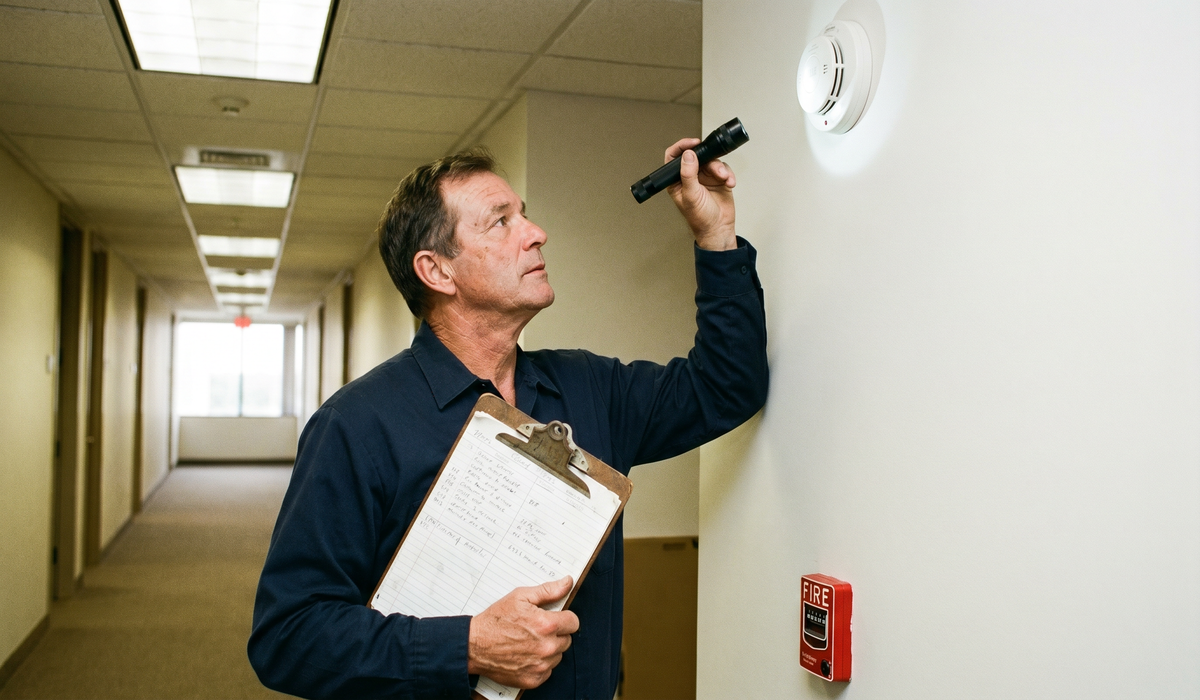
During the annual Inspection, Testing, and Maintenance (ITM) process, technicians must verify:
- Battery Backup: The system must maintain 24 hours of standby power, followed by 5 minutes of alarm operation.
- Device Functionality: Every smoke detector, heat detector, pull station, and notification appliance in the portable classroom must be physically tested.
- Integration Verification: For integrated systems, technicians must confirm that a signal originating in the portable classroom correctly registers on the main Fire Alarm Control Panel (FACP) and transmits to the monitoring center.
For a broader overview of statewide mandates, refer to our comprehensive guide on
California School Fire Alarm Requirements.
How Fire Testing Solutions Can Help
Managing fire alarm compliance across a sprawling campus with multiple portable classrooms is a complex logistical challenge. Fire Testing Solutions provides comprehensive support for Southern California school districts to ensure every building, permanent or temporary, meets state codes.
- System Integration and Installation:
We install and integrate fire alarm systems for new portable classrooms, ensuring seamless communication with your main campus FACP.
- Annual ITM Testing: Our licensed technicians perform complete NFPA 72 annual testing, ensuring that portable classrooms are never overlooked and that all documentation is inspection-ready.
- Deficiency Repairs: If a fire marshal cites a portable classroom for failing to meet the 25-foot integration rule or lacking two-way communication, we provide rapid code upgrades and repairs.
- 24/7 UL-Listed Monitoring: We provide continuous monitoring services to ensure that any alarm, whether from the main hall or a temporary classroom, is immediately dispatched to emergency responders.
Frequently Asked Questions
Do portable classrooms need their own fire alarm control panel?
If the portable classroom is integrated into the main campus system (located less than 25 feet away), it typically does not need its own main panel. It will connect to the existing FACP or a dedicated sub-panel. Stand-alone systems (more than 25 feet away) will require their own control unit.
Can we use battery-operated residential smoke detectors in a portable classroom?
No. Portable classrooms used for educational purposes must have commercial-grade, approved fire alarm systems that include manual pull stations and proper audio/visual notification appliances.
Who is responsible for ensuring the portable classroom meets fire codes?
The school district and the facility manager are ultimately responsible for ensuring that all buildings on campus, including leased or temporary portable classrooms, comply with California Fire Code and DSA requirements.
What happens if our portable classrooms fail the annual fire inspection?
Failing an inspection can result in citations, fines, and orders to correct the deficiency within a strict timeframe. In severe cases of non-compliance, the local Authority Having Jurisdiction (AHJ) may restrict the use of the building until the fire alarm system is brought up to code.
Conclusion
Portable classrooms are essential for managing school growth, but they cannot be treated as an afterthought when it comes to fire and life safety. Understanding the 25-foot integration rule, the two-way communication mandate, and the strict NFPA 72 testing requirements is the only way to ensure compliance and protect students. By partnering with a licensed fire protection contractor to evaluate and test these systems, school facilities managers can eliminate compliance blind spots and pass their annual inspections with confidence.
Need to integrate or test the fire alarms in your portable classrooms? Contact Fire Testing Solutions today to schedule an evaluation or annual inspection for your Southern California campus.
- Book a call:
https://www.firetestingsolutions.com/contact
- Phone Number: 866-757-8378
- Email: service@firetestingsolutions.com
- Address: 700 W. First St, Suite 10, Tustin, CA 92780
References
[1] Division of the State Architect. "IR A-1: Approval for Temporary School Use of DSA Approved Relocatable Buildings." https://www.dgs.ca.gov/-/media/Divisions/DSA/Publications/interpretations_of_regs/IR_A-1.pdf